 Add to Chrome
 Add to Firefox
 Add to Edge
asRoBallet: Closing the Sim2Real Gap via Friction-Aware Reinforcement Learning for Underactuated Spherical Dynamics
Apr 27, 2026
We introduce asRoBallet, to the best of our knowledge, the first successful deployment of reinforcement learning (RL) on a humanoid ballbot hardware. Historically, ballbots have served as a canonical benchmark for underactuated and nonholonomic control, which are characterized by a reality gap in complex friction models for wheel-sphere-ground interactions. While current literature demonstrates successful handling of 3D balancing with LQR and MPC, transitioning to actual hardware for a humanoid ballbot using RL is currently hindered by critical gaps in contact modeling, actuator latency & jitter, and safe hardware exploration, and safe hardware exploration. This study proposes a high-fidelity MuJoCo simulation that explicitly models the discrete roller mechanics of ETH-type omni-wheels, thereby capturing parasitic vibrations and contact discontinuities that are previously ignored. We also developed a Friction-Aware Reinforcement Learning framework that achieves zero-shot Sim2Real transfer by mastering the coupled rolling, lateral, and torsional friction channels at the wheel-sphere and sphere-ground interfaces. We designed asRoBallet through subtractive reconfiguration, repurposing key components from an overconstrained quadruped and integrating them into a newly designed structural frame to achieve a robust research platform at low cost. We also developed a generalized iOS ecosystem that transforms consumer electronics into a low-latency interface, enabling a single operator to orchestrate expressive humanoid maneuvers via intuitive natural motion.

Evolutionary Morphology Towards Overconstrained Locomotion via Large-Scale, Multi-Terrain Deep Reinforcement Learning
Jul 01, 2024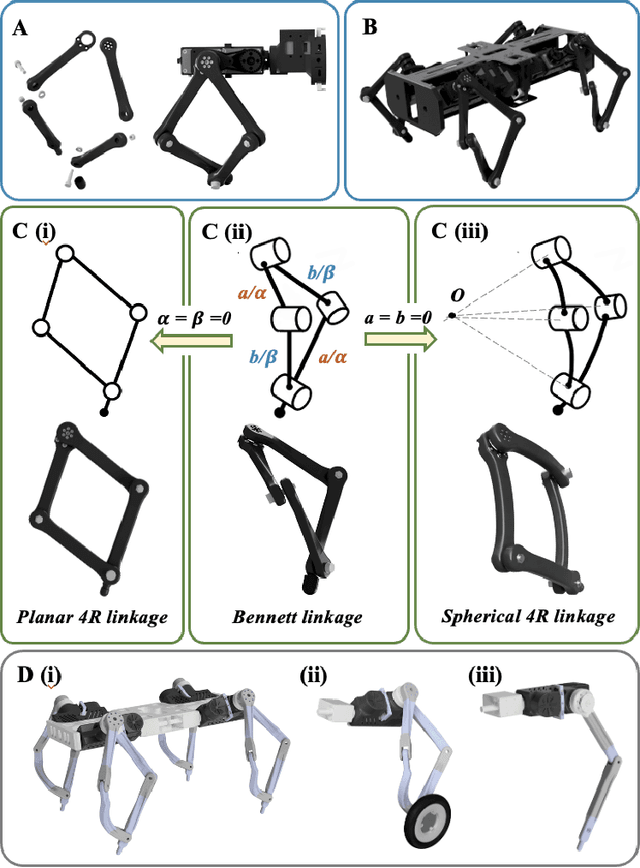
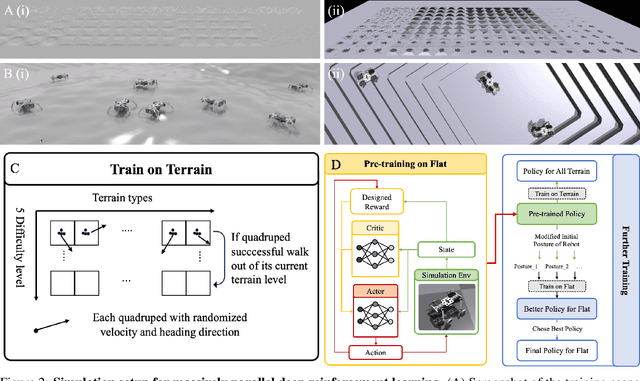
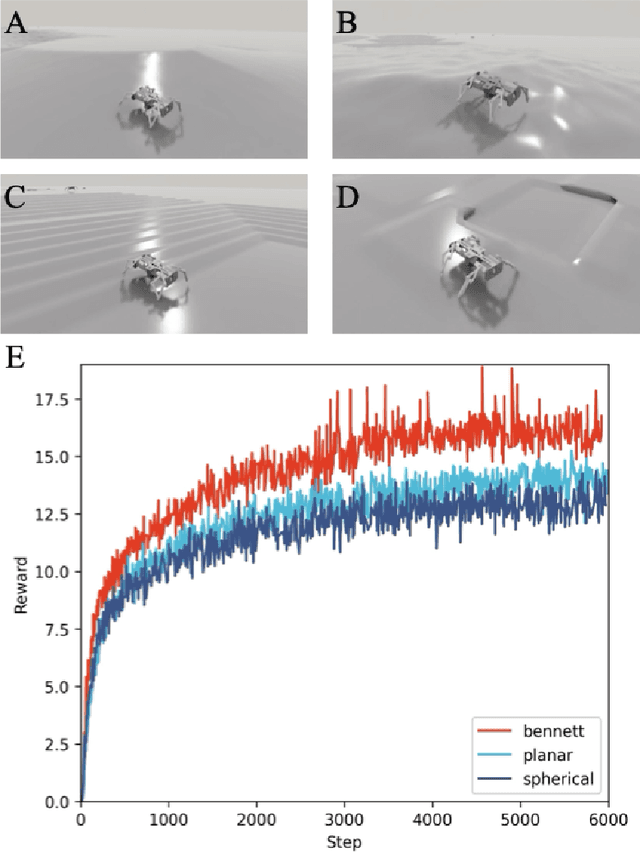
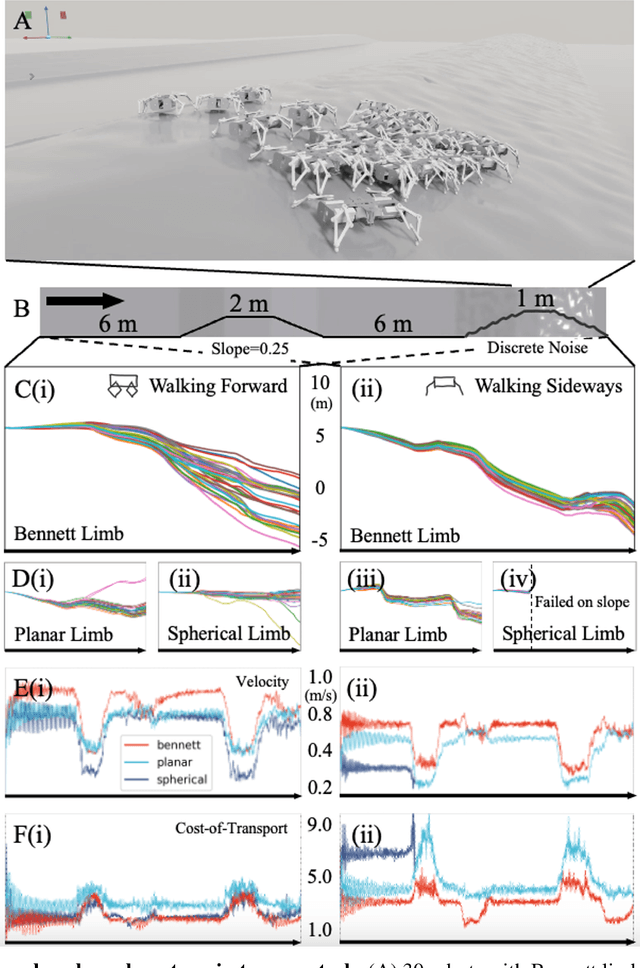
While the animals' Fin-to-Limb evolution has been well-researched in biology, such morphological transformation remains under-adopted in the modern design of advanced robotic limbs. This paper investigates a novel class of overconstrained locomotion from a design and learning perspective inspired by evolutionary morphology, aiming to integrate the concept of `intelligent design under constraints' - hereafter referred to as constraint-driven design intelligence - in developing modern robotic limbs with superior energy efficiency. We propose a 3D-printable design of robotic limbs parametrically reconfigurable as a classical planar 4-bar linkage, an overconstrained Bennett linkage, and a spherical 4-bar linkage. These limbs adopt a co-axial actuation, identical to the modern legged robot platforms, with the added capability of upgrading into a wheel-legged system. Then, we implemented a large-scale, multi-terrain deep reinforcement learning framework to train these reconfigurable limbs for a comparative analysis of overconstrained locomotion in energy efficiency. Results show that the overconstrained limbs exhibit more efficient locomotion than planar limbs during forward and sideways walking over different terrains, including floors, slopes, and stairs, with or without random noises, by saving at least 22% mechanical energy in completing the traverse task, with the spherical limbs being the least efficient. It also achieves the highest average speed of 0.85 meters per second on flat terrain, which is 20% faster than the planar limbs. This study paves the path for an exciting direction for future research in overconstrained robotics leveraging evolutionary morphology and reconfigurable mechanism intelligence when combined with state-of-the-art methods in deep reinforcement learning.